史密斯反内卷:技术AI深融突破之道
Home Appliance Industry Transformation: From Price War to High-Quality Value Competition Home Appliance Industry Transformation: From Price War to High-Quality Value Competition
Since the second half of 2024, the Ministry of Industry and Information Technology (MIIT) has repeatedly emphasized the need for "enterprises to explore new avenues through technological innovation." The policy orientation clearly points to a core goal: to abandon low-quality, low-efficiency price competition and move towards high-quality value competition.
Under the guidance of national strategic actions, the home appliance industry is also accelerating its pace of self-discipline and fair competition. In September 2025, the China Home Appliance Association issued a "Proposal for Strengthening Self-discipline and Fair Competition in the Home Appliance Industry," clearly pointing out the current problems of "involutionary"恶性 competition in the industry.
The home appliance industry, as a pillar industry related to people's livelihood, has long been trapped in the quagmire of "price for volume" involution, with frequent phenomena such as price wars and malicious defamation. Now, under the guidance of policies, market pressure, and the demonstration of leading enterprises, "eliminating waste and improving value" has become an irreversible direction, and the industry is facing a profound transformation.
Industry Ecosystem: The Pain of Involution in the Context of Stock Market Competition
For the domestic home appliance industry, 2025 was undoubtedly an anxious year. This "anxiety" is reflected in price wars, fluctuations in corporate profits, changes in senior management, and even mudslinging and public opinion wars. According to the latest monitoring data from iResearch, from January to October this year, the total retail sales of the Chinese home appliance market (excluding 3C) reached 758.4 billion yuan, an increase of 0.6%. Looking ahead to the full year, the home appliance market is expected to turn negative, not reaching the level of 2024.
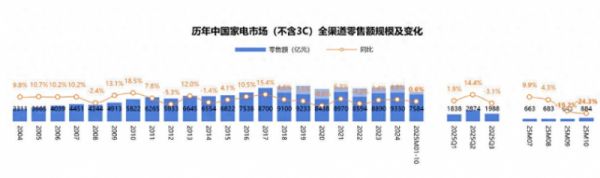
Data source: iResearch
In terms of A-share home appliance listed companies, few of them could maintain both revenue and net profit growth in the first three quarters of this year. According to a survey by Guoxin Securities, the overall revenue growth rate of 47 home appliance listed companies in 2025 Q3 slowed down; at the same time, the overall gross profit margin showed a decline. When the performance does not meet expectations, then "change people." This is also one of the reasons why home appliance companies frequently changed their leadership in the second half of this year.
This year, the home appliance industry also showed a "rare phenomenon": round after round of industry price wars, causing some provincial and municipal home appliance industry associations to "sit不住" and call for "combating involution." How did this "involution" come about? It dates back to the beginning of 2025. At that time, some white goods giants suddenly realized that they had lost a lot of market share in the low-end market and decided to change their market strategy, increasing the layout of low-priced products. With the giants' efforts, the brands in the third, fourth, and fifth-tier cities had to follow suit, and the fierce price war began.
Technological Excellence: Enterprises That Capture Real Needs Win in the Pain Points
The core logic of reversing the involution in the home appliance industry is never "low-price抢存量," but "technology expands增量." Those that can accurately capture the real concerns of Chinese families and explore innovative directions from complex scenarios such as water quality, space, safety, aging-friendly, and energy-saving, are crossing the fog of involution and seizing the development opportunities.
This trend is particularly evident in the washing machine market—under the background of falling industry average prices and intensified homogenization competition, multi-warehouse washing machines, by responding deeply to segmented needs, have broken through the stalemate of "micro-innovation," and become a typical example of breaking through involution in the washing machine track.
A.O. Smith, entering the Chinese market for 27 years, has deeply挖掘 local needs and adhered to "local innovation." For example, in response to the high water alkalinity corrosion problem in the north, A.O. Smith首创 "small and exquisite steel gas water heater," using a seamless steel heat exchange system, completely solving the problems of corrosion and scaling, and achieving lasting energy efficiency without degradation; in response to users' concerns about water purification efficiency, through TDS algorithm, accurately scheduling the innovative waterway system, perfectly controlling tds, and through waterway water purification backflow, achieving "full-time high water efficiency" through recycling and self-purification, ensuring that every cup of water is pure.
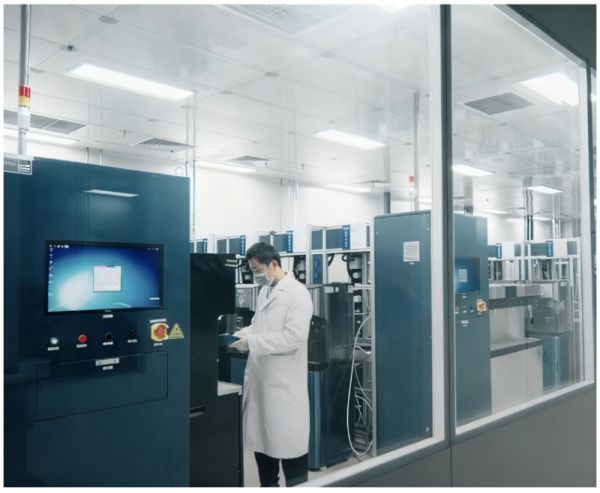
From third-party market monitoring data, A.O. Smith has always been at the top of the mid-to-high-end market for categories such as water heaters and water purifiers in China, helping and guiding the deep transformation of the Chinese industry towards "integration, intelligence, and health." This is also A.O. Smith's "break through involution" path with "technological excellence."
Behind this is that consumer demands are upgrading from "whether there is" to "whether it is good" and "whether it is refined," and industry competition is deeply changing from "price competition at the bottom" to "technological excellence." This demand-oriented technological innovation has completely jumped out of the low-level competition of "price war" and "parameter war," achieving a value upgrade from "satisfying basic needs" to "a better life."
Using AI to Break the Bottleneck: Home Appliance Companies Are All in
Overall, if there is a path that all home appliance brands will take, it is: AI. Not AI, and you will be eliminated, this has become a consensus of all players in the home appliance track.
This year, AI large models such as DeepSeek have broken through the application threshold through algorithms, boosting the fast track of industrial intelligentization. At the beginning of the year, home appliance companies have successively launched new products connected to AI large models such as DeepSeek, empowering home appliance innovation and upgrade. Various companies have applied AI algorithms accurately to improve interaction experience, automatic service, and energy-saving.
A survey by Giant Computation shows that 43.6% of consumers say they pay more attention to the "interactive experience" of home consumption. This change reflects that consumers are no longer satisfied with the basic functions of traditional home appliances, but have higher requirements for the integration of home appliances and life, as well as the convenience and intelligence of interaction. Therefore, in the process of home appliance intelligence, a core goal is to achieve the experience upgrade from "operating home appliances" to "satisfying needs." This transformation is realized through multiple dimensions of innovation.
From the current development status of AI smart home appliances, many brands are still停留在 the level of "device interconnection" or "voice interaction," lacking deeper levels of system collaboration and data closed loop. These initial stages of intelligence are difficult to achieve real scenario-based intelligence, and "active service" is even more unimaginable.
When AI home appliances are the demand, the correct breakthrough path for enterprises should be to integrate technology, experience, ecology, and service. Only through breakthrough AI innovation can a "blue sea" crack be opened in the red sea market.
In recent years, many capable leading manufacturers have been launching a major offensive on "smart home," seeking growth from ecology and incremental growth from scenarios. Among foreign brands, A.O. Smith is the one that has gone the deepest in AI home appliances.
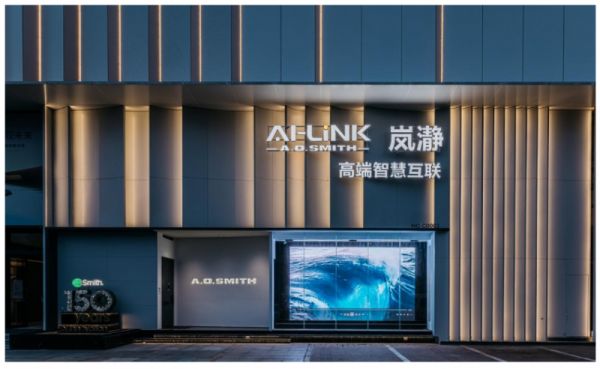
As early as 2020, A.O. Smith, with its ground-breaking smart interconnection solution AI-LiNK, strongly entered the new track of smart home. After that, AI-LiNK has continuously expanded its "friends circle," joining hands with partners such as Panasonic and Yingshi to create high-end and high-quality "good wind and water solutions."
A.O. Smith focuses on the "deep dive" of AI smart home, with AI-LiNK full connection and control as the core, integrating sub-systems such as water purification, heating, ventilation, and kitchen, achieving autonomous collaboration and intelligent decision-making of equipment. Its "digital true five constant integrated system" provides one-stop service from core equipment to construction and delivery, establishing a standardized and refined control system; the system is highly integrated, and the end is customized as needed, with real-time and accurate display of five constant data, integrating full air conditioning temperature control and radiant temperature control to achieve constant temperature, humidity, oxygen, cleanliness, and quietness in all dimensions; based on the Life-GPT large language model, it supports natural language interaction and can understand complex instructions, reconstructing the core logic of comfortable home with "good wind and water."
Industry Sorting: Manufacturers with "Differentiated Core" Win in the End
The home appliance market in 2025 is indeed easy to get lost. But the "final battle" of the home appliance industry has never been the zeroing of prices, but the reconstruction of value.
Recently, Huatai Securities released the "2026 Annual Outlook Series: Consumer Article: Home Appliances—New Opportunities in Intelligence," pointing out that in the Chinese market, future demand growth will rely on structural upgrades such as intelligence and high-end, and simple expansion of quantity is difficult to support the increase of market scale. In the future, the core competitiveness of enterprises will focus on "algorithm decision-making capability + ecological connection capability," and companies with AI core technology and scenario ecological layout will benefit first.
The Zhiyan Zhan Industry Research Institute believes that the global home appliance industry trend lies in: intelligence, high-end, health, and low-carbon. These "fourizations" can be summarized as: high value and differentiation. These two simple words comprehensively test the technological innovation capabilities of manufacturers.
What is differentiation? For example, after many years of innovation fatigue in the washing machine market, some manufacturers have launched "partition washing" and multi-warehouse washing machines, causing a sensation in the market, which is innovation. What is high value? A home appliance product with a high price can provide more value to consumers, and consumers are willing to pay for it. This is high value. The large user base of A.O. Smith's electric heat, gas heat, and water purification advantages can reverse pull the market penetration of kitchen appliances. At the same time, these solid products have become the natural entry and trust foundation for building the "AI-LiNK" whole-home intelligent ecology.
As the noise of price wars gradually subsides, the wave of technological innovation and value deepening is sweeping across the entire home appliance industry. The 2026 anti-involution struggle is not a simple industry self-discipline action, but a deep transformation related to the industry's future—from industry consensus under policy guidance to technical breakthrough in enterprise practice, and finally to experience upgrade driven by AI ecology. The home appliance industry is saying goodbye to the stock market competition of "price for volume" and moving towards the blue sea of "quality取胜" incrementally.
相关知识
A.O.史密斯的反内卷路径:以技术竞优与AI深融突围
史密斯反内卷:技术AI深融突破之道
富轩门窗涨价,899新品引领行业“反内卷”
聚焦洗碗机技术突破,A.O.史密斯自旋式洁霸洗碗机引领新潮流
A.O.史密斯获“突破创新奖”:家电至场景革新之道
涨价!富轩全屋门窗打响门窗行业“反内卷”第一枪,连甩两款“899性能王炸”新品!
A.O.史密斯AI战略:技术深耕,服务至上,生态共赢
中融玻璃总裁高江:提供差异化产品,突破内卷,找到新的增长点
富轩全屋门窗打响门窗行业“反内卷”第一枪,连甩两款“899性能王炸”新品!
A.O.史密斯的AI路径:技术、服务与生态的长期主义
网址: 史密斯反内卷:技术AI深融突破之道 http://m.fulushijia.com/zhidaoview22701.html